
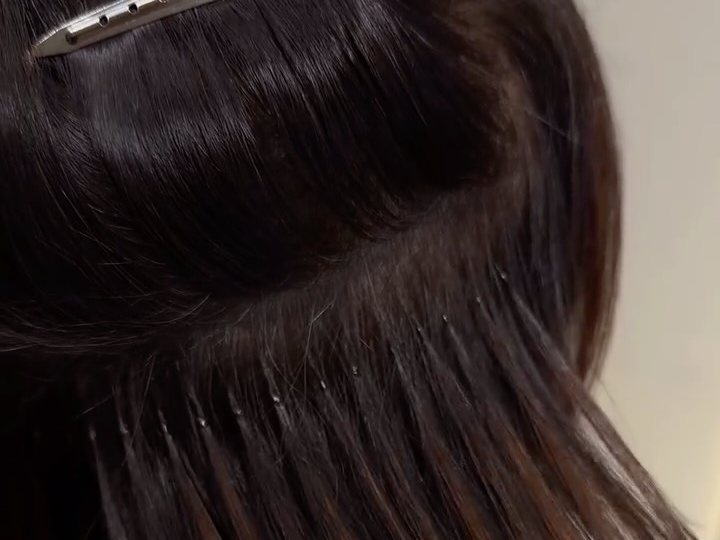
When clients worry before getting extensions, it's rarely about the look – it's almost always about health: "Will it damage my scalp?", "Will I lose hair because of it?", "What if it itches?" Those are fair questions. Your scalp is the foundation for healthy hair, and any extensions mean extra weight and a change in your routine. In this article I'll explain what happens to your scalp with keratin bonds, which sensations are normal and when you should pay attention.
Where exactly the bond sits – and why it matters
A keratin bond isn't attached to the scalp but to the hair itself, about 0.5–1 cm from the root. So the scalp never comes into contact with heat or keratin. That's an important difference from methods where adhesive is applied close to the root. For the scalp underneath to "breathe" and be cleaned properly, that gap is essential – bonds placed too close are one of the most common causes of tension and irritation.
Normal: what you might feel in the first few days
- A slight feeling of tension or of something foreign for the first one to three nights. Your head needs to get used to the small bonds – a bit like after a tight ponytail.
- A little more weight, especially with lots of length. After a few days it feels completely natural.
- Mild itching in the first week, mainly because you shouldn't wash for the first 48 hours and your scalp is processing new sensations.
These sensations should have largely disappeared after about a week.
Not normal: warning signs to take seriously
- Persistent pain or pulling in one spot after more than three or four days – a strand is too tight or too close to the scalp.
- Redness, little spots or weeping areas around the bonds.
- Strong, ongoing itching that doesn't improve after washing.
- Bald or noticeably thinner patches under the bonds.
In all these cases: please don't wait – get in touch. A single strand that's too tight can be fixed in minutes. For skin reactions, I'd also recommend seeing a dermatologist.
"So much hair!" – the big misunderstanding at maintenance
Almost every client gets a shock at their first maintenance appointment when we remove the bonds and comb out. What looks like a whole handful of hair comes out. The explanation: we all lose around 50–100 hairs a day. Normally they fall out one by one and disappear unnoticed into the brush or the drain. With bonds, these shed hairs are held in the strand. After six to eight weeks that quickly adds up to several thousand hairs – which would have fallen out naturally anyway. That's not hair loss caused by extensions; it's normal shedding that's been collected.
Can extensions cause hair loss?
Yes – when done wrong. The medical term is traction alopecia: hair loss from constant pulling on the follicles. It's not caused by the method itself but by:
- strands that are too heavy relative to the natural hair carrying them,
- too much total weight for fine or thin hair,
- constantly tight hairstyles such as very tight, high ponytails,
- maintenance postponed for too long, so the leverage keeps increasing.
With correctly sized, fine bonds and regular maintenance, this risk is very low. That's exactly why honest advice on the number of grams matters – more in our grams guide and our article on fine and thin hair.
Scalp care with extensions: how to do it
Wash properly
Your scalp needs just as much cleansing as without extensions. Gently massage shampoo with your fingertips directly onto the scalp between the rows of bonds – no scratching, no rubbing. A mild, sulphate-free shampoo cleans thoroughly without attacking the bonds. More in our aftercare guide.
Dry thoroughly
Moisture that lingers on the scalp between the bonds is the perfect breeding ground for itching and dandruff. So blow-dry the root area after every wash – on a medium setting; the lengths can air-dry. Never go to bed with damp roots.
Products on the lengths only
Oils, masks and leave-ins belong on the lengths, not the scalp. They weigh the roots down, make the bonds slippery and can clog pores.
For dandruff or a dry scalp
Choose a mild anti-dandruff or scalp shampoo and apply it only to the scalp. Liquid (non-oily) scalp serums can be dropped directly between the rows of bonds with a pipette.
A scalp break: do I need one?
If you wear extensions for many months and your scalp is healthy, a break isn't necessary. At every maintenance appointment your scalp gets a short "day off", is washed and checked anyway. But if you've noticed irritation, are shedding more after pregnancy or illness, or simply feel like treating your hair, a break of a few weeks can make sense. If the strands are in good condition, we'll keep them for you.
Common questions
Can I see a dermatologist or have an MRI with extensions?
Scalp examinations are easy between the rows of bonds. Keratin bonds contain no metal, so an MRI isn't a problem either – unlike micro rings. If in doubt, check with the practice beforehand.
Is scalp massage OK with extensions?
Gentle fingertip massage while washing boosts circulation and is fine. Just avoid vigorous rubbing or pulling directly at the bonds.
Our takeaway
Correctly applied keratin bonds don't touch your scalp and, in the right amount, don't strain it. Slight tension in the first few days is normal; persistent pain, redness or bald patches are not. With thorough cleansing, good drying and timely maintenance, your scalp stays healthy – and so does the hair carrying your extensions.