
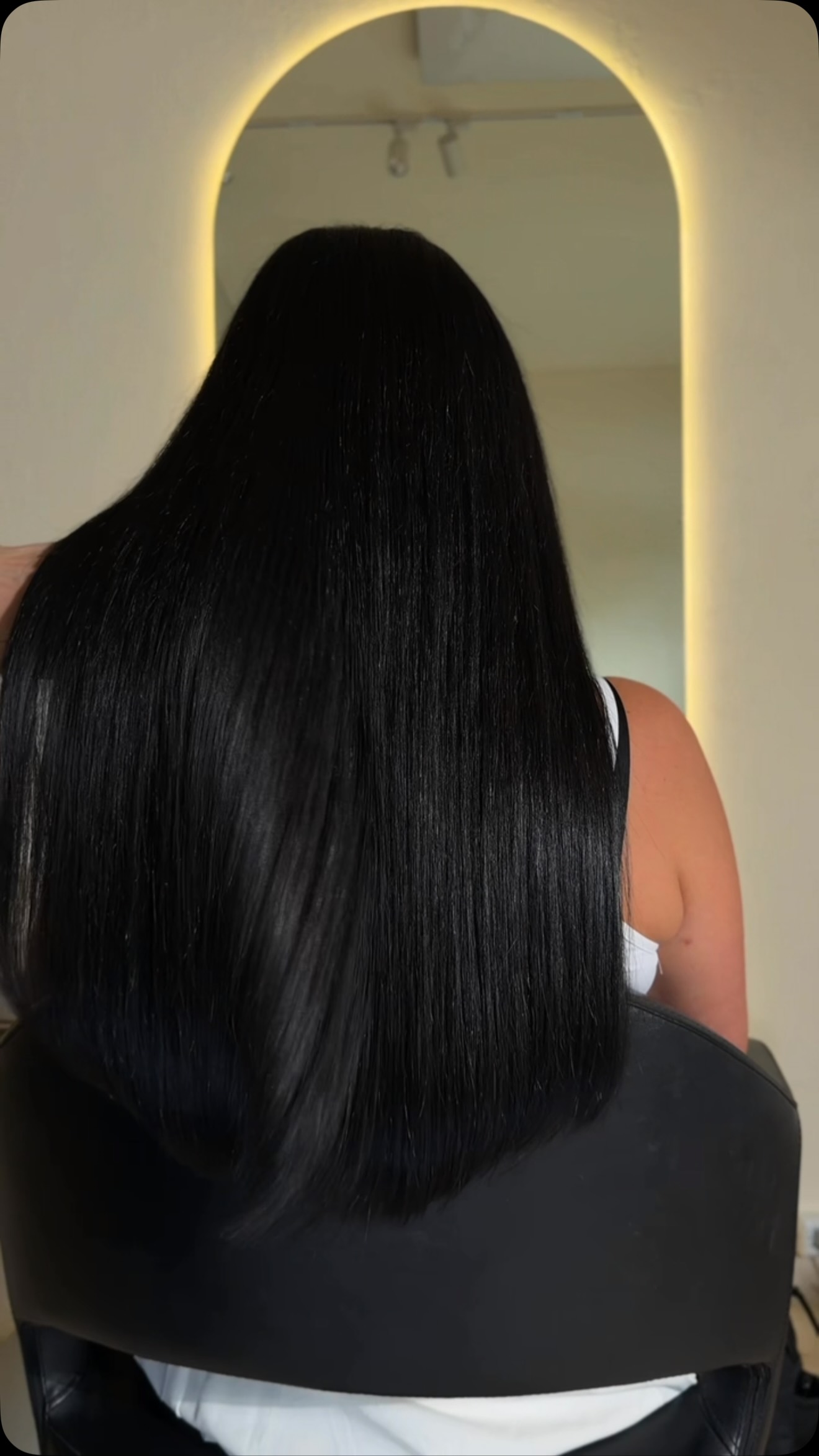
"Do I really need another maintenance appointment already?" I hear this in the salon almost every week. And I get it: at six weeks your extensions often still look great, and another appointment costs time and money. But the maintenance appointment (in Germany we call it the Korrektur) is the single most important reason invisible keratin bonds stay gentle on your own hair and look natural month after month. In this article I'll walk you through what actually happens during a maintenance appointment, when to book it, and what goes wrong if you put it off for too long.
Why maintenance is necessary in the first place
Natural hair grows on average around 1–1.5 cm per month. A freshly applied keratin bond sits roughly 0.5–1 cm from the scalp and moves down with every millimetre of growth. After eight weeks it's already 2.5–4 cm below the root. That has three consequences:
- The bonds start to show. In a ponytail, a bun or on a windy day, they peek through because the hair at the root no longer covers them.
- More leverage on your own hair. The longer the section of natural hair between scalp and bond, the more the strand swings – and the more tension each individual hair has to carry.
- Tangling at the root. Naturally shed hairs (we all lose 50–100 a day) get caught on the bond and combine with new growth to form small knots.
The right timing: every 6–8 weeks
For most clients I recommend maintenance every 6–8 weeks, and no later than three months. How soon you need it depends on a few things:
- Growth rate: fast growers (during pregnancy, for example, or when taking biotin) are usually closer to 6 weeks.
- Hair texture: fine, soft hair tangles at the root faster than thick, straight hair.
- Styling habits: if you often wear your hair up, you'll notice grown-out bonds sooner.
- Aftercare: brushing regularly while holding the hair at the root noticeably extends the interval – see our aftercare guide.
A quick self-check: run your fingers down a strand starting at the scalp. If you only feel the bond after more than a finger's width (about 2 cm), it's time to book.
What a maintenance appointment at Shanta Hair looks like
Maintenance isn't a fresh start – it's a careful repositioning of the strands you already have. Here's how it works in our Ottobrunn salon:
- Check-up: I look at your scalp, your natural hair and the extensions themselves – are the ends still healthy, is there any breakage?
- Gentle removal: each bond is softened with a special remover fluid and carefully crushed with pliers so the strand slides out without any pulling. Your own hair is never tugged or cut.
- Combing out: keratin residue and the naturally shed hair of the past weeks are combed out thoroughly. Many clients are startled by "all that hair" – it's completely normal, it's simply the shedding that would otherwise have been spread over several weeks.
- Scalp wash: your scalp is cleansed and gets a short break.
- Re-bonding: the removed strands are trimmed straight and re-bonded by hand with fresh keratin – in the same tiny, invisible size as your first appointment.
- Reapplication: the strands go back in close to the root, topped up with a few new ones if needed to restore your volume.
Depending on the amount of hair, maintenance takes around 3–5 hours, so plan for a relaxed half day.
How many times can my hair be reused?
Good-quality human hair with an intact cuticle can usually be re-bonded 2–3 times, which means roughly 6–9 months of wear with proper care. Each time, the strands lose a few millimetres (the old bond is cut off) and around 10–15% of their volume. That's why we often add 10–20 g of fresh hair during maintenance so your fullness stays the same. To work out how much hair you need overall, check our grams guide.
Cheap hair with a damaged or chemically stripped cuticle, on the other hand, often tangles after the very first cycle and is hard to reuse at all. This is where the price difference between premium and budget hair really shows.
What happens if you skip maintenance?
Being a couple of weeks late is no big deal. Pushing it back by months is a different story:
- Matting at the root: small knots turn into solid mats that take a lot of patience – and sometimes scissors – to undo.
- Breakage: the extra leverage can snap your natural hair right above the bond, leaving the bond plus a piece of your own hair in the brush.
- Tension on the follicle: constant pulling can irritate the scalp and, in the worst case, cause hair loss in heavily loaded areas.
- Higher cost: badly matted strands often can't be reused and removal takes longer – you end up paying more than for a timely appointment.
Maintenance or a break? Both are fine
Not everyone wants to wear extensions all year round. If you'd like a break, we remove the bonds just as gently as during maintenance – we simply don't put them back in. Your natural hair gets a treatment, and if the strands are in good condition you can keep them for later. Please never remove bonds yourself with oil or by pulling them out: that's the most common cause of damage that then gets wrongly blamed on the method itself.
How much does maintenance cost?
Because you don't need to buy a full set of new hair, maintenance costs considerably less than the first application (from €7/g including labour). The exact price depends on the number of strands and whether fresh hair is added. The easiest way: send me a photo of your roots on WhatsApp and you'll get a concrete estimate before you book.
Our takeaway
Maintenance isn't an annoying extra appointment – it's the reason invisible keratin bonds are so gentle on your hair when done properly. Come in every 6–8 weeks and your extensions stay invisible and tangle-free, and you can reuse your hair several times, which actually saves money in the long run. Tip: book your next appointment before you leave the salon, so it doesn't get lost in everyday life.