
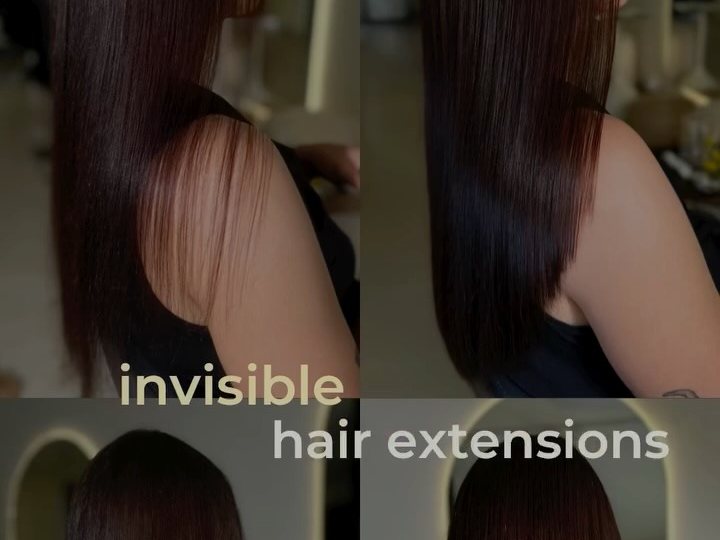
"My hair is so thin – is this even possible for me?" Clients with fine hair often ask me this in their very first WhatsApp message, sometimes almost apologetically. The honest answer: in the vast majority of cases, yes. Women with fine or thin hair are actually among those who benefit most from extensions – because even a small amount of extra hair makes a huge difference. But fine hair is less forgiving of mistakes. Method, amount and aftercare have to be just right. In this article I'll explain what matters.
Fine vs. thin – not the same thing
In everyday language the words are used interchangeably, but for planning extensions the difference matters:
- Fine hair describes the diameter of each individual hair. Every strand is thin and soft, but you can still have lots of them.
- Thin (sparse) hair describes density – how many hairs grow per square centimetre on your head. Your ponytail is slim, and the scalp shows through.
Many women have both. Fine hair mainly determines how light and small each strand needs to be. Thin hair determines how many strands your head can carry overall and how they should be distributed.
Why keratin bonds are often the best choice for fine hair
With tape-ins, a wide adhesive strip is sandwiched between two sections of hair. On fine hair these tapes tend to show through, and the weight concentrates on a broad section. Hand-made keratin bonds, on the other hand, can be sized individually. For fine hair we make extra-small micro bonds with less hair per strand. That has three advantages:
- The weight is spread over many small points instead of a few large ones.
- The bonds are so flat they stay invisible even under little top hair.
- The hair falls naturally and can be styled in any direction.
For more on how the methods compare, read keratin bonds vs. tape-ins.
How many grams for fine hair?
This is where the most common mistake happens: too much hair. Put 150 g into thin hair and you'll get an instant full mane – but your own hair has to carry a weight it wasn't built for. As a rough guide for fine hair:
- More volume, no extra length: 40–60 g, placed strategically on the crown and sides.
- Moderate lengthening (up to about 45 cm): 60–90 g.
- Significant lengthening (50 cm and beyond): ideally in two stages – 70–90 g first, then a careful top-up after a few months if your hair is coping well.
These are guide values – I always set the exact amount only after feeling your hair. Our grams guide explains this in detail.
Realistic length: it's all about the transition
With fine hair, the length itself isn't the problem – the transition is. If your own hair is shoulder-length and thin but the extensions are thick and waist-length, you get a visible "step": little on top, lots at the bottom. The bigger the length difference, the more hair it takes to blend – and that's exactly what you shouldn't ask of fine hair. My advice: plan 10–15 cm less than your absolute dream length. The result looks more natural and your hair will thank you. You can always add more in a few months.
Placement: where the strands go
With thin hair, I don't just place strands in even rows. What matters:
- Enough space between bonds so each strand is carried by plenty of natural hair.
- Enough top hair above the highest row so nothing shows through.
- Targeted filling where it makes the biggest visual difference – often the sides and the nape, where thin hair looks most wispy.
- No strands in very sparse areas, such as the temples or along a wide parting.
Aftercare: what fine hair with extensions needs
The basics from our aftercare guide apply here too, plus a few extras:
- Use lightweight products. Heavy masks and oils weigh fine hair down at the root and make the bonds slippery. Conditioning products belong on the lengths only.
- Gently brush through the roots every day. Fine hair tangles around the bond faster than coarse hair.
- Never go to bed with wet hair. Damp, fine hair is especially sensitive to friction.
- Book maintenance closer to 6 weeks than 8. The finer the hair, the sooner it's worth going – see our article on maintenance.
- Avoid tight ponytails. A loose, low ponytail is far gentler on the roots than a tight high one.
When I advise against extensions
There are cases where even the finest bonds aren't a good idea: acute, heavy hair loss, round bald patches, an inflamed scalp, or very brittle, freshly bleached hair. In those situations, have the cause checked by a doctor first. Extensions can disguise a lot, but they're not a treatment – and on weakened hair they'd make the problem worse.
What you can realistically expect
With well-planned extensions, fine hair looks visibly fuller, your ponytail gets thicker and the ends no longer look thin and wispy – with a result nobody will recognise as extensions. What extensions can't do is change the structure of your hair at the root. Your parting stays your parting. Still, many clients are surprised how much "just a little more" makes.
Our takeaway
Fine or thin hair doesn't rule out extensions – quite the opposite. The keys are small, light keratin bonds, a carefully chosen number of grams, a realistic length and slightly more frequent maintenance. That way you get more fullness without overloading your natural hair. Feel free to send me a photo of your hair in daylight, both down and in a ponytail – I can give you an honest assessment before you even book.