
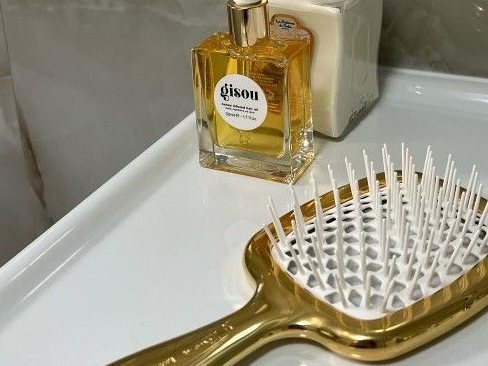
After their first appointment, many clients find themselves standing in front of the shelf at the chemist wondering: which of these can I still use? The choice is huge, the promises on the bottles are big – and not everything that's good for your natural hair is good for keratin bonds. In this article I'll explain which products really belong in your bathroom, which ingredients to avoid and where you can save money.
The basic rule: clean roots, nourished lengths
Almost every aftercare rule for extensions comes down to one sentence: cleanse at the roots, condition the lengths. The area with the bonds needs thorough but gentle cleansing and no greasy products. The lengths, on the other hand, need moisture and protection because they don't get nourishment from the scalp. How to wash properly is covered in our everyday aftercare guide.
Shampoo: mild and sulphate-free
Shampoo is the most important product, because it touches the bonds every time you wash. Look for:
- Sulphate-free formulas. Strong surfactants such as sodium lauryl sulphate or sodium laureth sulphate cleanse very aggressively, dry out the lengths and can make the keratin brittle over time.
- No 2-in-1 products with built-in conditioner – otherwise the conditioning agents end up at the roots.
- Caution with very rich shampoos full of oil. What's lovely on the lengths makes the bonds slippery.
- Purple shampoo for blonde extensions: once a week against brassiness – no more often, or it dries the hair out.
Conditioner and masks: lengths only
Conditioner is a must for extensions – but only from about chin level down, a hand's width away from the bonds. Once a week, swap the conditioner for a mask. Products with moisturising ingredients such as glycerine, panthenol, aloe vera or hyaluronic acid are good choices. For very dry ends, masks with keratin or proteins help too – but not every wash, as too much protein can make hair stiff.
Leave-ins, oils and serums
- Leave-in spray: light and ideal after every wash; it makes brushing easier and protects against dryness.
- Hair oil: sparingly, one or two drops on the ends – never at the roots. Light oils like argan or jojoba are better than heavy ones.
- Heat protection: essential before every blow-dry, straightening or curling session. A spray distributes more evenly than a cream.
- UV protection: useful in summer and on holiday so the colour doesn't fade.
Ingredients to avoid at the roots
- Oils and butters (e.g. coconut oil, shea butter) directly on the bonds – they soften the keratin.
- High-alcohol sprays in large amounts – they dry out bonds and lengths.
- Heavily silicone-based products at the roots – they make the bonds slippery and build up.
- Harsh scrubs and scalp exfoliants with coarse particles that get caught in the bonds.
Silicones on the lengths, by the way, are no problem – they smooth and protect. It's all about where the product ends up.
The right brush
The wrong brush can loosen bonds and pull out hair. Tried and tested:
- Dedicated extension brushes with soft, flexible loops or rounded bristles that glide over the bonds instead of catching.
- Mixed natural-bristle brushes to smooth the surface and reduce static.
- A wide-tooth comb for detangling wet lengths.
Avoid brushes with little balls on the bristle tips – bonds get caught in them particularly easily.
Accessories worth having
- A silk or satin pillowcase – less friction, fewer tangles.
- A microfibre towel or cotton T-shirt to gently squeeze out water instead of rubbing.
- Spiral ties and silk scrunchies instead of elastics with metal.
- A hairdryer with temperature settings – medium for the roots.
Where you can save
You don't need ten different products. A solid basic kit is enough: sulphate-free shampoo, conditioner, a mask, a leave-in with heat protection and a good brush. Expensive specialist products "just for extensions" often aren't necessary as long as the ingredients are right. Invest instead in a good brush and a silk pillowcase – they make the biggest difference day to day.
Care by season
In summer the focus is on UV protection and rinsing out salt and chlorine thoroughly; in winter it's moisture against dry heating air. More in our article on autumn and winter. For blonde extensions, an occasional gloss in the salon is also worth it – see colouring and toning.
Common questions
Can I keep using my current shampoo?
If it's sulphate-free and not very oily: yes. Feel free to bring your products to your appointment and we'll look at the ingredients together.
How often should I wash?
Two to three times a week is ideal for most people. Dry shampoo in between is fine but should be brushed out thoroughly so it doesn't collect at the bonds.
Do I really need a special extension brush?
Not strictly, but it makes daily brushing much more pleasant and gentle. If you only make one investment, make it this one.
Are natural or organic shampoos suitable?
Often, yes, since most are sulphate-free. Do check the oil content, though – some natural shampoos contain a lot of plant oils that can be a problem at the roots.
Our takeaway
The best care for extensions is simple: a mild, sulphate-free shampoo at the roots, moisture and protection on the lengths, no oils on the bonds, and a brush that glides rather than tugs. With this basic kit your keratin bonds stay clean until your next maintenance appointment, and your hair can be reused several times.