
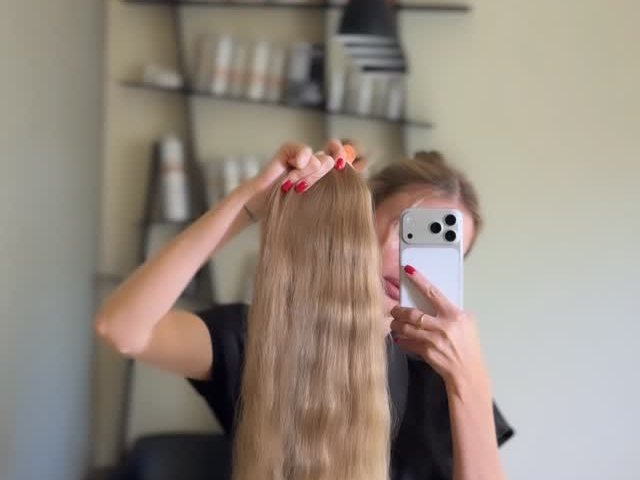
When you compare prices for hair extensions, you'll notice big differences – sometimes double or triple for what looks like the same service: "100% human hair, 50 cm, 100 g". The reason almost always lies in the hair itself. Not all human hair is equal, and the labels on packaging and websites all sound equally promising. In this article I'll explain what the common terms actually mean, how you can check quality yourself and why good hair usually pays off in the long run.
Why hair quality matters so much
The method – in our case invisible keratin bonds – determines how the strands are attached. The hair determines everything else: how naturally it falls, how it feels, how long it lasts without tangling, whether it can be coloured and heat-styled, and how often it can be reused at maintenance. The best technique can't rescue bad hair.
The key terms – and what they really mean
Remy hair
With Remy hair, the hair is cut and processed so that every strand points the same way – root to root, tip to tip – and the cuticle stays intact. This is the single most important quality factor: when the cuticle scales all face the same direction, the hairs glide past each other instead of catching.
Non-Remy hair
Here, hair is collected without regard to direction – from combed-out hair, for example. To stop it tangling instantly, the cuticle is stripped in an acid bath and the hair is coated in silicone. The result: beautifully shiny in the shop, dull, dry and knotted after a few washes.
Virgin hair
Hair that has never been chemically treated – never dyed, bleached or permed. It's especially robust but only available in natural shades (usually dark). For light blondes, every hair has to be lightened. That's not a flaw if it's done gently.
"Russian", "Slavic" or "European" hair
These origin labels describe finer, softer hair that's structurally similar to European hair. Genuine hair of this origin is rare and correspondingly expensive. Unfortunately, the labels are often used as pure marketing. Ask where the hair really comes from – and trust what you feel more than the label.
Single drawn vs. double drawn
"Single drawn" means the strand contains hairs of different lengths, so it tapers towards the ends – like natural hair. "Double drawn" means shorter hairs have been removed so the strand is evenly thick right to the tips. Double drawn is more labour-intensive and more expensive but gives fuller ends. Which suits you best depends on your natural hair and the look you want.
How to check quality yourself
Ask to touch the strands during your consultation. These simple tests already tell you a lot:
- The finger test: take a single hair between thumb and forefinger and slide from tip to root. Remy hair with an intact cuticle feels slightly resistant; in the other direction it glides smoothly.
- The shine test: healthy hair has a silky sheen, not an artificial greasy one. An extreme, plastic-like shine suggests silicone coating.
- The ends test: look closely at the tips. Lots of very short hairs, split ends or little knots are bad signs.
- The smell test: a strong chemical smell points to aggressive processing.
- The reuse question: ask how many times the hair can typically be re-bonded. An honest answer for good hair: several times.
Why cheap hair ends up costing more
Let's be honest about the numbers: cheap hair may cost significantly less per gram. But if it tangles after six to eight weeks and has to be fully replaced at the first maintenance, you're paying full price for new hair every two months. Quality Remy hair, with careful aftercare, can be moved up several times, so at maintenance you mostly pay for the work and only occasionally top up with some fresh hair. Over six months, good hair is therefore often actually cheaper – and you have nicer hair the whole time.
Then there are the hidden costs of bad hair: more time detangling, more products just to keep it combable, and in the worst case damage to your natural hair from constant tugging at matted spots.
What we use at Shanta Hair
We work exclusively with Remy human hair with an intact cuticle, carefully selected for texture and colour. Every strand is bonded by hand in our salon – which lets us tailor bond size and the amount of hair per strand exactly to your hair. Our price of from €7/g including labour includes exactly that quality. To work out how much hair you need, see our grams guide.
Aftercare: even good hair needs attention
Extensions get no nourishment from the scalp. Even the best hair therefore needs care in the lengths: mild, sulphate-free shampoo, a light conditioner on the ends, heat protection when styling, and regular, gentle brushing. You'll find all the tips in our aftercare guide.
Common questions
Can I colour my extensions?
Quality human hair can generally be toned or dyed darker. Lightening is risky, though, because the hair has usually already been lightened. Please only have extensions coloured in a salon.
How do I know my hair can't be reused any more?
If the ends are heavily thinned out, the hair feels straw-like even after conditioning, or it knots constantly, it's time for new hair. At maintenance I'll tell you honestly what's still possible.
Our takeaway
The most important difference between premium and cheap hair is invisible: an intact, aligned cuticle. It decides whether your extensions are still silky after three months or matted. Ask questions, touch the hair – and think long-term. Good hair quickly turns out to be the cheaper option.