
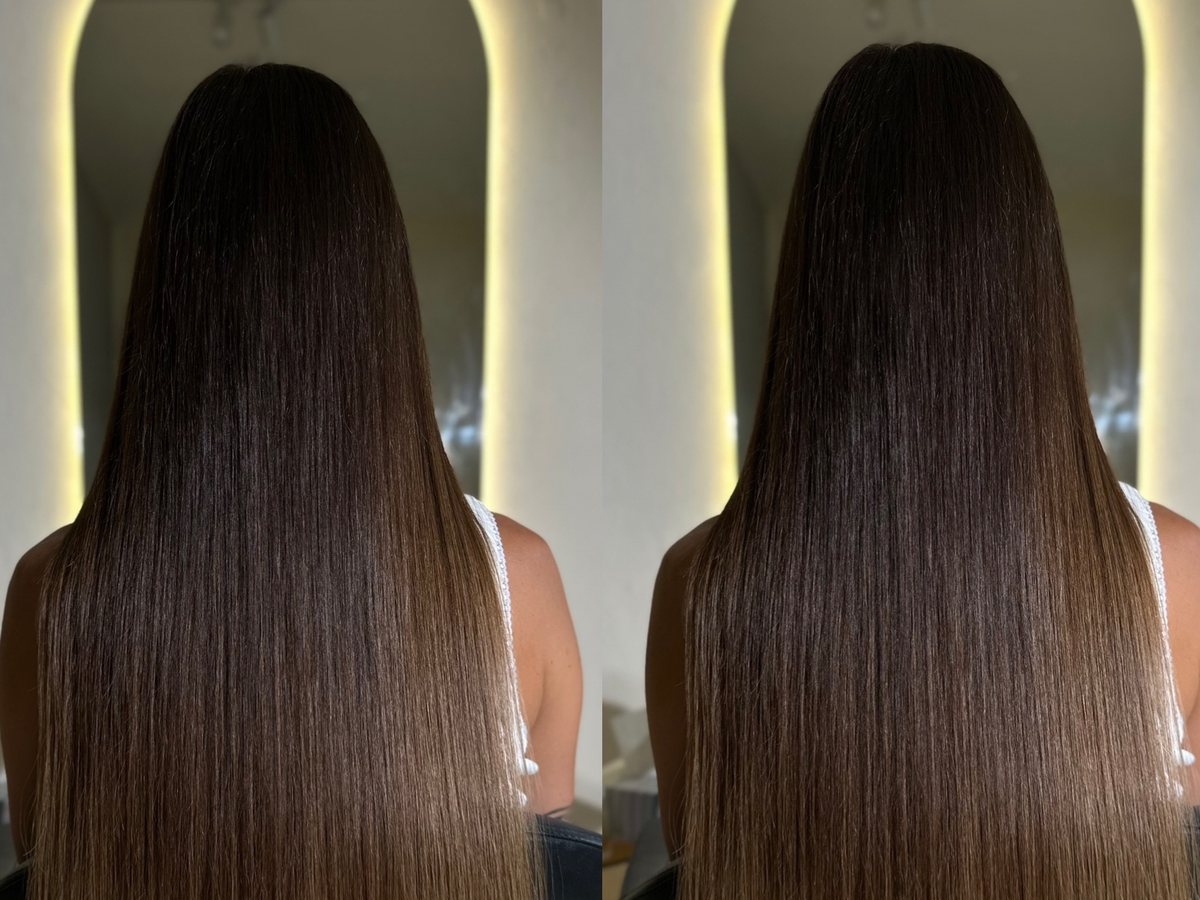
You can have the finest bonds and the most expensive hair in the world – if the shade is wrong, the extensions show immediately. A mismatched tone is the most common reason extensions look "fake". The good news: with the right approach, almost any hair colour can be matched so well that even your best friend can't tell where your hair ends and the extensions begin. In this article I'll explain how we match colour at Shanta Hair – and what you can do to help.
Why one shade is rarely enough
Take a really close look at your hair in daylight. You'll notice it isn't one colour but many. The root is usually a little darker, the lengths lighter from sun and washing, the ends often lighter or warmer still. Then there are individual lighter and darker hairs that give depth. An extension strand in a single, flat shade quickly looks out of place next to that natural interplay.
That's why in most cases we blend two or three tones. The result: a lively, multi-dimensional look that melts into your natural hair.
What matters when matching colour
1. The ends of your natural hair
Extensions have to match above all where they meet your hair – at the level of your own ends. That's where it's decided whether the transition shows. If your ends are lighter than the rest, that's what we match.
2. The undertone
At least as important as light or dark is the question: warm, cool or neutral? A warm golden blonde next to a cool ash blonde instantly looks "wrong", even at the same lightness. With blondes and browns in particular, undertone is the most common pitfall.
3. Bond colour
The keratin bonds themselves come in different colours too – from transparent to dark brown. They're matched to your roots so they disappear into your hair.
4. The light
Salon light, daylight, evening light, a phone camera – every light source shows colour differently. So we always check the shade at the window in daylight and hold the strands against several areas of your hair.
Typical colour situations – and how we solve them
- Natural brown: often a mix of a cooler brown for depth and a slightly warmer one for reflections.
- Blonde with darker roots: a combination of root shade and length shade so the gradient stays soft.
- Balayage or ombré: we blend lighter strands specifically where your balayage sits – or use multi-tonal strands.
- Very dark hair or black: black isn't just black – pure blue-black often looks too harsh on natural dark brown. A very dark brown usually fits better.
- Red and copper tones: the most challenging, because red is highly individual and fades quickly. We often work with a blend and plan a gloss to fine-tune.
- Grey strands: if you don't colour your grey, we can blend it in naturally with light, cool tones.
How to take the perfect photos for a colour consultation
Many clients send me photos via WhatsApp for a first assessment. For the colour to come across accurately:
- Daylight, by a window – but not in direct sun.
- No filter, no beauty mode, no editing.
- Dry, unstyled hair, ideally without shine spray.
- Three photos: the back of your head with hair down, a close-up of the roots and one of the ends.
- If possible: a white sheet of paper in one shot – it helps me judge the camera's white balance.
We always confirm the final colour in the salon, directly against your hair.
Before or after colouring?
If you want to change your hair colour, please colour before getting extensions – about a week before. Then we match the extensions to the fresh colour. What you can do colour-wise once extensions are in is covered in our article on colouring and toning.
The cut does the rest
Even the perfect colour only looks natural if the transition is right. After application I cut your hair and the extensions together so there's no harsh line and the colours flow into each other. I explain the whole appointment in your first appointment.
What if the colour changes over time?
Sun, chlorine, salt water and heat styling change hair colour over time – natural hair and extensions slightly differently. That's why we check at every maintenance appointment whether the tone still matches. Small differences are evened out with a gloss or by blending in a few new strands.
Common questions
Can I order my shade myself from a catalogue?
Colour numbers vary from manufacturer to manufacturer, and screens never show colour exactly. So always have the shade matched directly against your hair.
How many different shades are blended?
Usually two or three. With very even, natural hair one tone may be enough; with elaborate balayage, more.
Do bonds show in blonde hair?
For light hair we use light or transparent bonds that disappear at the root. With dark roots and light lengths, we match the bond colour to the roots, not the lengths.
What if I can't decide between two shades?
Then a blend of both is usually the best solution. It looks more natural than either shade on its own.
Our takeaway
Natural-looking extensions come from blending rather than a single flat tone, the right undertone, matching bond colours, a daylight check and a good blending cut. Take your time over the colour consultation – it's at least as important as the technique itself.