
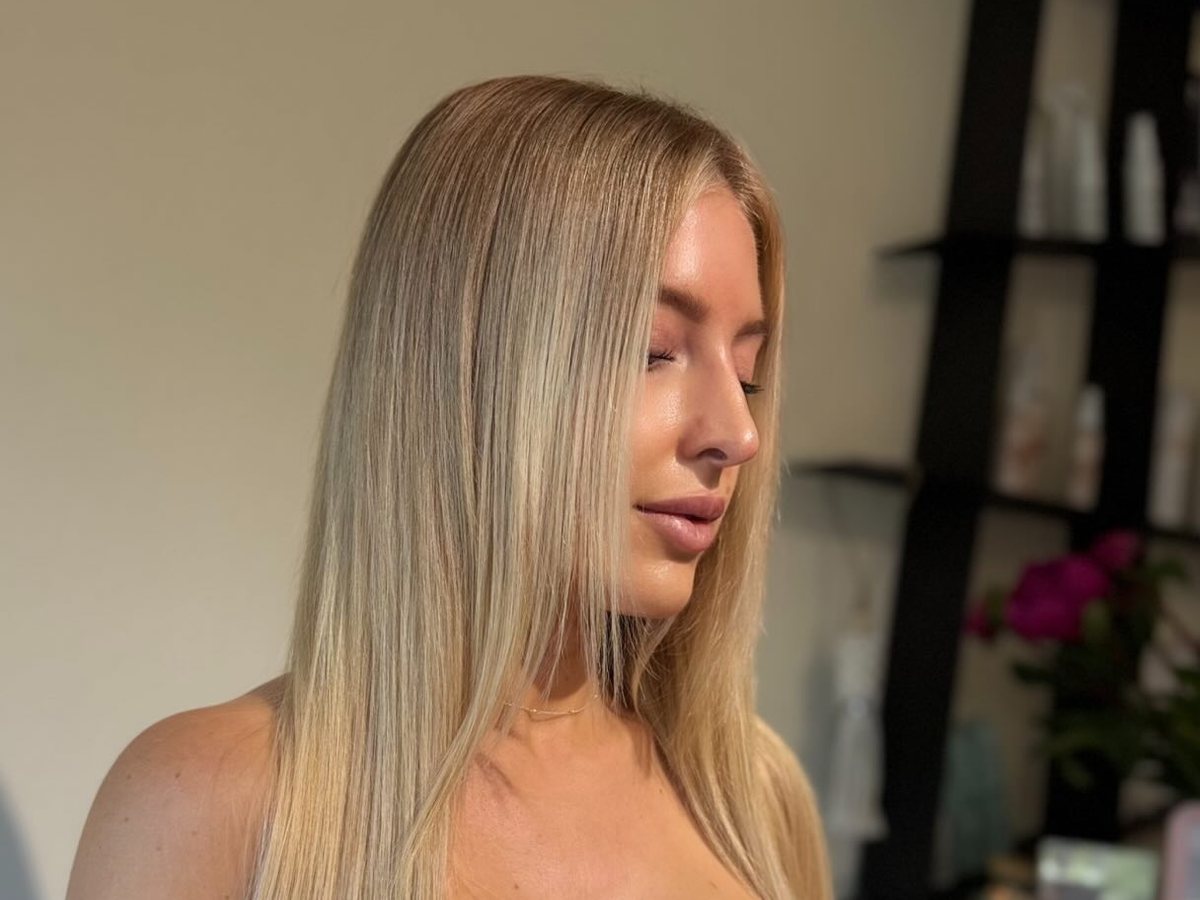
Few beauty topics are surrounded by as much half-knowledge as hair extensions. In almost every consultation I hear things like "my friend's hair was ruined afterwards" or "you can always tell they're not real". Some of these worries have a grain of truth; many date from a time when salons worked with chunky glue dots and cheap hair. Here are the seven myths I come across most often – and what's actually true after more than 11 years of experience.
Myth 1: "Extensions ruin your natural hair"
Partly true – but only when done badly. Damage from extensions almost always comes from one of four causes: strands too heavy for the amount of natural hair, bonds that are too big, skipped maintenance, or DIY removal at home. When strands are fine enough, matched to your hair density and maintained every 6–8 weeks, the weight is spread so your hair carries it without trouble. Many of our clients have worn extensions for years – with healthy hair underneath.
Myth 2: "You can see the bonds straight away"
False – if they're done properly. The bonds many people picture were the size of rice grains and didn't match the hair colour. Modern hand-made keratin bonds are tiny, flat and tinted to match your roots. We place them so that even a high ponytail keeps them covered by the top layer. Bonds only start to show once they've grown out – which is exactly why timely maintenance matters.
Myth 3: "No sport, no sauna, no beach with extensions"
False. With keratin bonds you can work out, swim, go to the sauna and lie on the beach. There are a few simple rules: tie your hair up for sport and swimming, rinse out salt and chlorine promptly, and don't sit in the sauna for hours. All the details are in our everyday aftercare guide.
Myth 4: "Extensions are only for women with thick hair"
False – but the planning is different. Women with fine or thin hair often benefit the most. The difference: the strands need to be extra fine, the number of grams is chosen more carefully, and not every dream length makes sense straight away. A good salon will more likely suggest 80 g than 150 g for fine hair – and that's exactly what protects it.
Myth 5: "Human hair is human hair – the price difference is just marketing"
False. There's a world of difference between quality Remy hair with an intact cuticle and cheap hair where the cuticle has been chemically stripped and coated in silicone. The cheap hair often looks even shinier on day one – but after two or three washes the silicone is gone, the hair tangles and can hardly be reused. Quality hair, by contrast, lasts through several maintenance appointments. In the long run, good hair is often the cheaper choice.
Myth 6: "Having them put in hurts"
False. Keratin bonds are attached to your hair with a heat clamp, at a distance from the scalp. At most you'll feel slight warmth on the strand. For the first night or two your head may feel unfamiliar, a bit like after a very tight ponytail – that settles quickly. Real pain or persistent pulling is not normal, though: it means a strand is too tight and should be adjusted.
Myth 7: "You can take extensions out yourself at home"
Please don't. This is the myth that does the most damage in practice. Trying to loosen bonds with oil, fingernails or by pulling almost always rips out natural hair too. In the salon, each bond is softened with a special remover and crushed with pliers so the strand slides out with no tension. It takes a little longer – and your hair stays intact.
Bonus: "Extensions always look fake"
Whether extensions look natural comes down to three things: the shade (ideally blended from two or three tones), the transition between your hair and the extensions (the cut after application is crucial) and the amount. If someone with very fine hair suddenly has a thick waist-length mane, it will always stand out. Plan realistically, and you'll get a result that makes even fellow hairdressers look twice.
And when are extensions genuinely not a good idea?
Honesty is part of the job: there are situations where I advise against extensions, or at least suggest waiting. These include acute, heavy hair loss (after an illness or shortly after giving birth, for example), an irritated, inflamed or flaky scalp, hair that has just been heavily bleached and is brittle as a result, and very short hair under roughly 8–10 cm where the bonds simply can't be covered. In those cases it's better to find the cause first, care for your hair or let it grow a little. A good stylist will tell you that openly – even if it means losing an appointment.
Lifestyle matters too: if you don't have the time or inclination for maintenance every few weeks, keratin bonds won't make you happy in the long run. For special occasions, clip-ins may then be the better choice.
What's actually true: the short version
- Well-done extensions don't damage your hair – badly done ones do.
- Invisibility is a matter of bond size, colour and placement.
- Sport, sauna and holidays are fine with a few simple rules.
- Fine hair can be extended too, if the amount and strands are right.
- Hair quality is the biggest factor in longevity and reuse.
- Application and removal belong in professional hands.
Our takeaway
Most extension myths come from bad experiences with outdated methods, unsuitable hair or no proper consultation. With fine keratin bonds, quality hair and regular maintenance, extensions today are a safe and very natural option. Got a question this article didn't answer? Message me – I'll give you an honest answer, even if it's occasionally "better not".