
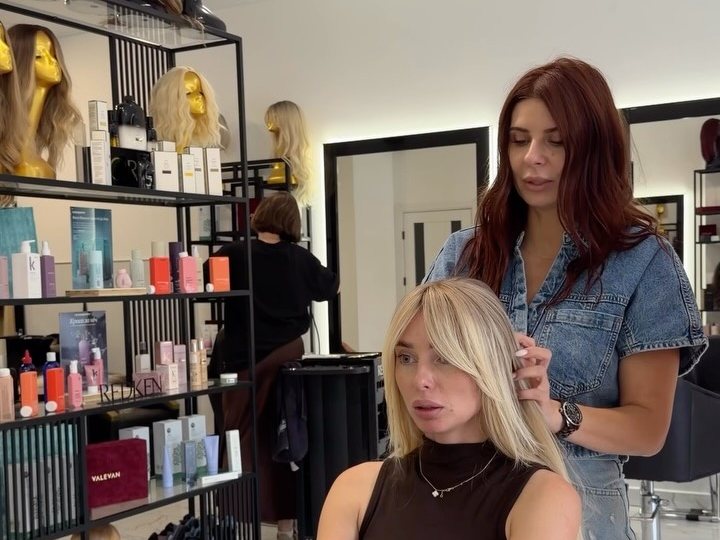
Search for "hair extensions Munich" and you'll get dozens of results – from big chain salons in the city centre to specialists who do nothing but extensions. Prices range from suspiciously cheap to very expensive, and on Instagram every result looks perfect. But extensions are not a small decision: your own hair carries the strands for months, and a poor application can leave real damage behind. After more than 11 years in this job, I'd like to give you an honest checklist – whether you end up booking with us in Ottobrunn or not.
1. Qualifications and specialisation
In Germany, any hairdresser is allowed to apply extensions – there's no mandatory specialist training. That makes it all the more important to ask the right questions:
- Is the stylist trained and certified? A master or chamber of crafts (HWK) qualification shows that someone learned the craft properly and understands hair structure, scalp and chemistry.
- How many years of extension experience specifically? Clean, tiny keratin bonds take hundreds of applications to master.
- Are extensions a core service or a side offer? A salon that does extensions every day usually has far more routine in colour matching, placement and maintenance.
2. The method – and whether it suits you
A good salon won't just sell you whichever method it happens to offer; it will explain why a technique works for your hair. At Shanta Hair we work with invisible, hand-made keratin bonds because, for most hair types, they give the most natural look and the most freedom of movement. For a detailed comparison with tape-ins, see our article keratin bonds vs. tape-ins.
Ask specific questions: How big are the bonds? How many strands will be placed? How far from the root? The smaller and finer the attachments, the less strain on each hair – and the more invisible the result.
3. Where the hair comes from and how good it is
The hair makes up a large part of the price – and most of the result. A reputable salon can tell you exactly:
- whether it's genuine Remy hair, with every hair lying in the same direction and the cuticle intact,
- how the hair was coloured or lightened,
- how many times it can be reused (good quality survives several maintenance appointments).
Ask to see and touch the strands before your appointment. Quality hair feels soft but not "slippery". A strong silicone shine can be a sign that the cuticle has been chemically stripped and then coated – hair like that often tangles within a few weeks.
4. The consultation: your best quality test
A good consultation is free, non-binding and takes longer than five minutes. Pay attention to whether the stylist:
- looks at and feels your natural hair and scalp before quoting,
- tells you honestly what won't work – say, 70 cm of length on very fine, chin-length hair,
- gives you a specific number of grams and a price rather than a vague range (our grams guide explains how that's calculated),
- mentions the follow-up costs: maintenance every 6–8 weeks, aftercare products, removal.
If you leave without anyone explaining aftercare or when your first maintenance is due, that's a bad sign.
5. Transparent pricing
Extensions in Munich typically cost anywhere from several hundred to over a thousand euros, depending on method, hair quality and amount. Reputable salons quote a clear price per gram or per strand – ours, for example, is from €7/g including labour. Be wary of offers advertising a very low "from" price that suddenly doubles on the day because you supposedly need more hair. And very cheap all-in packages almost always cut corners on hair quality or on the time spent on your strands.
6. Real results, not stock photos
Look at the salon's Instagram or gallery – but look closely. Are there close-ups of the roots? Are there clients with ponytails or updos where bonds would show? Are the photos unedited and spread over several months? A salon that's confident in its work shows the details, not just finished curls from behind.
7. Hygiene, time and atmosphere
A first application takes several hours depending on the amount. Do you feel comfortable in the space? Are the tools kept clean? Is enough time scheduled, or does everything feel rushed? With keratin bonds placed one by one by hand, calm is a quality factor – under time pressure, strands end up uneven or too close to the scalp.
Five questions for your consultation
Write these down before you go, so nothing slips your mind during the appointment:
- How many grams do you recommend for my hair – and why exactly that amount?
- What hair quality do you use, and can I see the strands beforehand?
- How long will the application take, and when is my first maintenance due?
- What does maintenance cost, and how many times can the hair be reused?
- What happens if I'm not happy with the result or a strand comes loose?
The answers often tell you more about a salon than any photo. A stylist who answers confidently, specifically and without dodging knows their craft.
Red flags at a glance
- No consultation – just "we can do it today".
- No information on where the hair comes from.
- Large, visible bonds in the salon's own photos.
- No explanation of aftercare or maintenance.
- A price that jumps unexpectedly on the day.
- Being told you can "just remove them at home with oil".
What about location? Munich or the suburbs
Many of our clients come to us in Ottobrunn from central Munich, Neubiberg, Unterhaching, Haar or Putzbrunn. The upside of a salon on the edge of the city: easy parking and a calmer setting for long appointments. Since you'll come back for maintenance every few weeks, it does make sense to choose somewhere you can reach easily – but quality always comes before distance.
Our takeaway
The right extension salon is the one that tells you honestly what's possible with your hair, works with high-quality hair, quotes transparent prices and looks after you after the appointment too. Take the time for one or two consultations, ask the questions on this checklist – and trust your gut.