
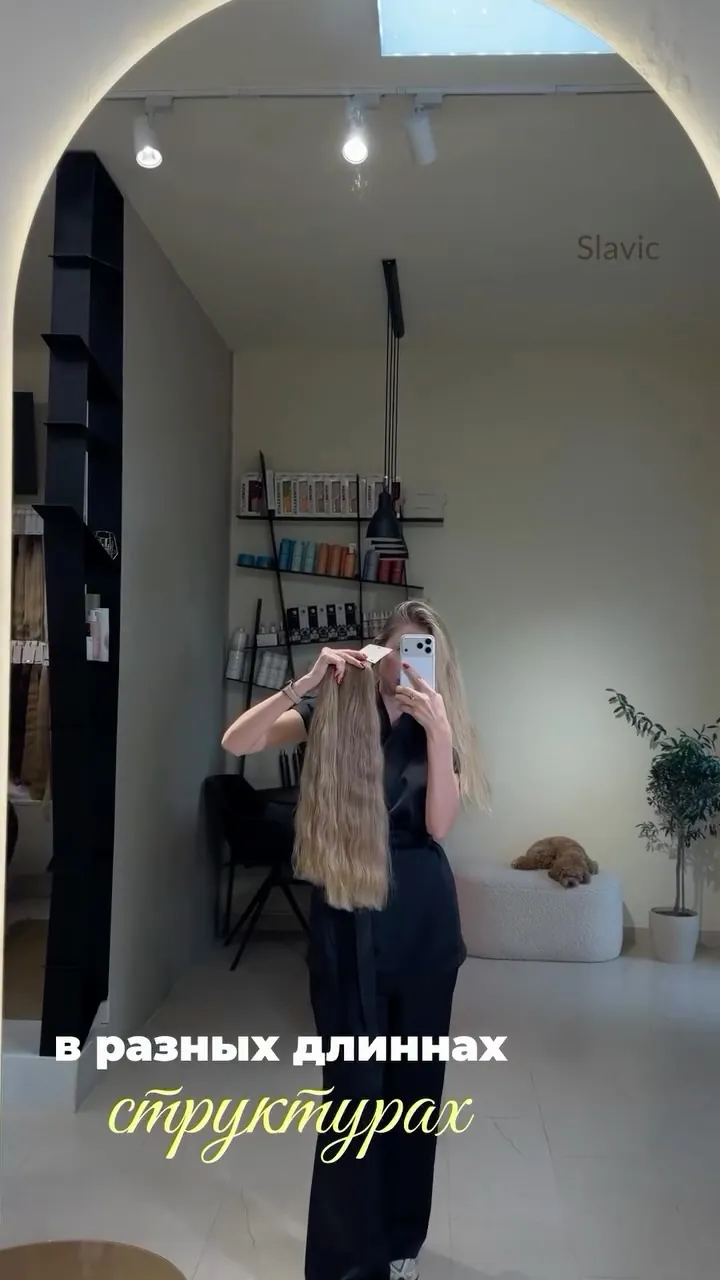
Suddenly the ponytail feels thinner, the parting looks wider and your hair simply isn't as full as it used to be. Many women notice this from their mid-forties, often around the time other menopause symptoms begin – and rarely talk about it. It is completely normal and has nothing to do with doing something wrong. As a stylist with more than 11 years of experience, I want to explain why hair thins during this stage of life, when keratin bonds can be a lovely solution, and what we pay special attention to.
Why does hair get thinner during menopause?
As oestrogen and progesterone levels drop, the hair growth cycle changes. The growth phase gets shorter, the follicles become finer and each strand gets thinner in diameter. At the same time, follicles react more sensitively to the small amounts of male hormones every woman has. The result is rarely a bald patch; it is usually diffuse thinning, mostly around the parting, the temples and the crown.
Typical signs include:
- a parting that keeps getting wider,
- less volume in your ponytail,
- hair that feels finer and softer and breaks more easily,
- more hair in the brush or the shower drain than you are used to.
Please note: I'm a stylist, not a doctor. If your hair loss starts suddenly, you notice round bald spots, or your scalp itches or hurts, please see a dermatologist or gynaecologist first. Thyroid and iron levels are also common, treatable causes. Hair extensions don't replace treatment – they are a cosmetic solution for more fullness.
What keratin bonds can do at this stage
Unlike a hairpiece or topper, keratin bonds attach each strand individually and very thinly to your own hair. The result moves with your hair, can be washed and styled as usual, and looks like your own from the outside. It works best when there is still enough natural hair for the strands to hold on to – which is the case for most women in menopause.
Our handcrafted micro-bonds are tiny and flat. With finer hair that is crucial, because large, heavy attachments would show and put unnecessary strain on your delicate natural hair.
Less is more: how we plan for hormonally thinning hair
This hair type calls for different maths than young, dense hair. Together we plan what you really need:
A few lightweight strands
Instead of the maximum amount, we prefer 40 to 70 grams of very light strands, evenly distributed. That is often enough to make a ponytail look full again and soften the parting without overloading your own hair. We settle on the exact amount during the free consultation after looking at your hair density.
Placement away from the thinnest areas
Right where hair is thinnest – at the crown and directly at the parting – we place no bonds or only very few. Instead we work behind and to the sides, where there is more stable natural hair. The longer strands of your own hair then cover the thinner areas above.
Keeping length and weight in check
With delicate hair we deliberately choose extension lengths that aren't much longer than your own. A harmonious transition looks better and is gentler than a mane pulling on fine roots.
Care and touch-ups
You can wash and style your hair as usual. We recommend an oil-free shampoo and drying the roots thoroughly. Dyeing and toning is possible too, including at the roots. Touch-ups are usually needed every 3–4 months, depending on how fast your hair grows. With very fine hair we like to check a little earlier the first time to see how your hair carries the strands. You don't need to buy new hair: we remove the strands, renew the keratin bonds and re-apply the same hair.
A tip from daily practice: if your scalp tends to get dry during menopause, choose gentle care and brush softly. A soft brush and gentle detangling from the ends upward protect both roots and bonds.
What does it cost?
Invisible keratin micro-bonds start at €8.50 per gram at our salon. The price includes the hair, the bond preparation and the application work. A subtle top-up with around 50 grams starts at roughly €425. The consultation is free, and you'll know in advance what amount to plan with.
What else you can do for your hair
- Have your blood values checked: iron, ferritin, vitamin D and thyroid are common factors.
- Eat a balanced diet: hair needs enough protein, iron and zinc.
- Massage your scalp gently: it boosts circulation and feels good.
- Avoid tight hairstyles: tight ponytails put extra strain on fine roots.
- Cut down on heat: a heat protectant before blow-drying or straightening spares hair that is already more delicate.
My conclusion
Thinning hair during menopause is nothing to be ashamed of – and nothing you simply have to accept. A few lightweight, well-placed keratin bonds can rebuild fullness that looks natural and goes unnoticed in everyday life. What matters is honest advice that protects your own hair instead of overloading it. That is exactly what you get with us in Ottobrunn.